RiflescopeV10 1–10×28 NXT
- Reticle Fine Cross
- Second focal plane
- CT glass + ED objective
- Suspended metal reticle
Item no. 442000303
DDoptics · At home outdoors
Your pursuit. Your view. Your riflescope.
Your application comes first
A compact design for thermal clip-ons, a wide field of view for hunting or a tac-A glass reticle for long range: each series has its own strengths. Explore the differences and jump straight to the models that suit you.


Generation 3 ↘Proven riflescopes for demanding hunters – NFX-level optical quality with a narrower field of view.DDoptics · NXT
A 10× zoom range, CT glass and ED objective lenses form the optical foundation. Choose from three magnification ranges, with manual or automatic illumination control.

Suitability · DDoptics recommendation

★★★★Thermal clip-on: 4 out of 4 starsItem no. 442000303

Suitability · DDoptics recommendation

★★★★Thermal clip-on: 4 out of 4 starsItem no. 442000303.1

Suitability · DDoptics recommendation
★★★★Thermal clip-on: 4 out of 4 stars
★★★★Mountain hunting: 4 out of 4 starsItem no. 442000300

Suitability · DDoptics recommendation
★★★★Thermal clip-on: 4 out of 4 stars
★★★★Mountain hunting: 4 out of 4 starsItem no. 442000300.1

Suitability · DDoptics recommendation
★★★★Thermal clip-on: 4 out of 4 stars
★★★★Mountain hunting: 4 out of 4 starsItem no. 442000301

Suitability · DDoptics recommendation
★★★★Thermal clip-on: 4 out of 4 stars
★★★★Mountain hunting: 4 out of 4 starsItem no. 442000300.1x

DDoptics · NFX
Our flagship comes first: the 2.5–20×56 Supershort. It is followed by the 2.5–15×56 and 2.5–15×50 models, each available with manual illumination or iFiber.

Suitability · DDoptics recommendation
★★★★Thermal clip-on: 4 out of 4 stars
★★★☆Mountain hunting: 3 out of 4 starsItem no. 442511146

Suitability · DDoptics recommendation
★★★★Thermal clip-on: 4 out of 4 stars
★★★☆Mountain hunting: 3 out of 4 starsItem no. 442511146.1

Suitability · DDoptics recommendation
★★☆☆Thermal clip-on: 2 out of 4 stars
★★★☆Mountain hunting: 3 out of 4 starsItem no. 442511127

Suitability · DDoptics recommendation
★★☆☆Thermal clip-on: 2 out of 4 stars
★★★☆Mountain hunting: 3 out of 4 starsItem no. 442511127.1

Suitability · DDoptics recommendation
★★☆☆Thermal clip-on: 2 out of 4 stars
★★★☆Mountain hunting: 3 out of 4 starsItem no. 442511134

Suitability · DDoptics recommendation
★★☆☆Thermal clip-on: 2 out of 4 stars
★★★☆Mountain hunting: 3 out of 4 starsItem no. 442511134.1

Optical NFX System
High light transmission, high-contrast images and quality mechanics define the NFX series. The Supershort model combines a 56 mm objective with a compact design.
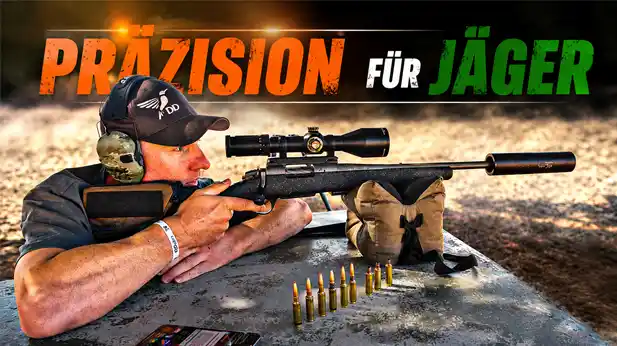
This JAGD TOTAL video shows the NFX prototype in use in Namibia, offering an insight into the development of today's Premium series.
The video link opens YouTube.
DDoptics · TACTICAL
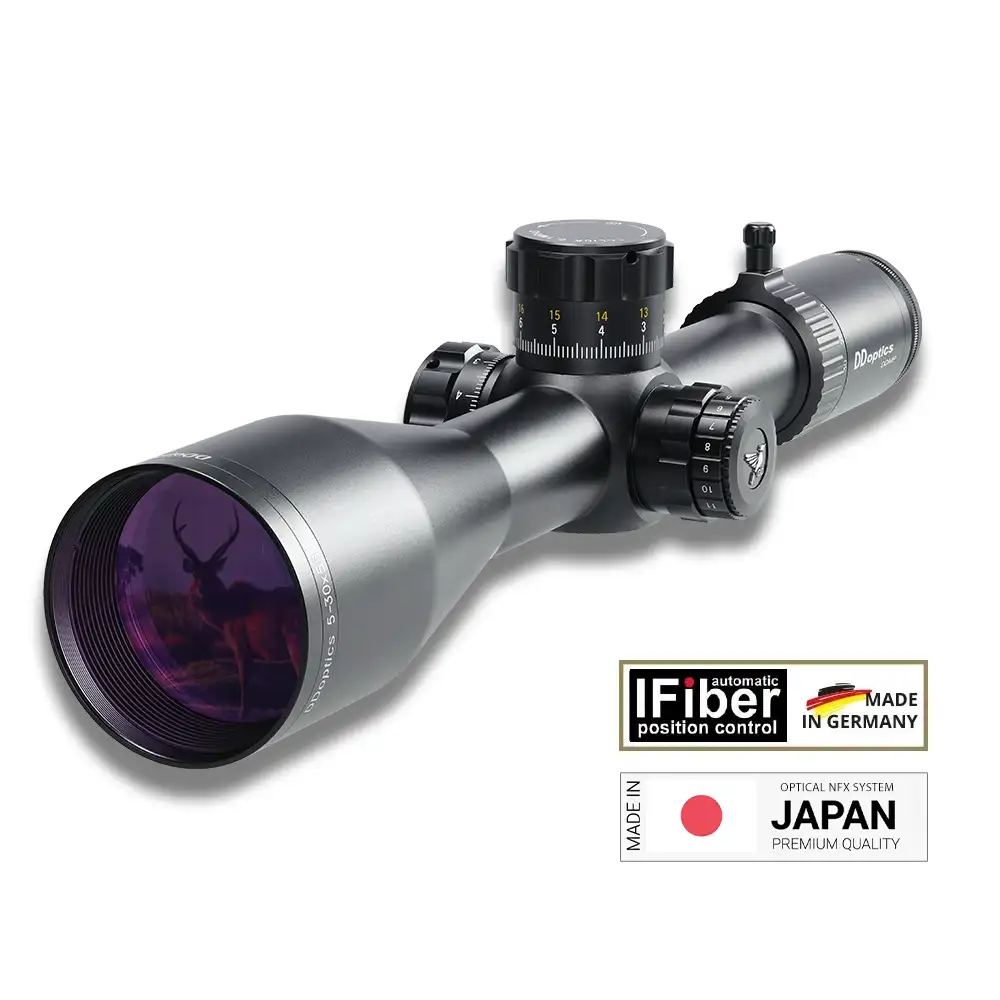
The 5–30×50 NFX combines a wide magnification range with a MilDot reticle. For target shooting, long-range shooting and hunting, from the mountains to Africa.

Suitability · DDoptics recommendation
★★★☆Mountain hunting: 3 out of 4 starsApplications
Item no. 442511144

Suitability · DDoptics recommendation
★★★☆Mountain hunting: 3 out of 4 starsApplications
Item no. 442511144.1

Compared with the previous generation, the 5–30×50 NFX Tactical offers a wider field of view and more comfortable viewing. An easy-grip magnification ring and a second-focal-plane MilDot reticle complete its feature set.
DDoptics · DDMP
5–30×56 and 4–40×50, each available in MRAD and MOA versions. Designed for long-range and target shooting, with mountain hunting also among their applications. Manual and automatic versions are shown separately.

Applications
Item no. 442511131

Applications
Item no. 442511131.1

Applications
Item no. 442511132

Applications
Item no. 442511132.1

Applications
Item no. 442511137

Applications
Item no. 442511137.1

Applications
Item no. 442511141

Applications
Item no. 442511141.1
This film with Bunsi puts the DDMP 5–30×56 through an endurance test in Namibia.
The video link opens YouTube.
DDoptics · A proven series
The remaining Gen3 model in the current range. Two versions, built on the same proven platform.

Suitability · DDoptics recommendation
★★★☆Mountain hunting: 3 out of 4 starsItem no. 442511129

Suitability · DDoptics recommendation
★★★☆Mountain hunting: 3 out of 4 starsItem no. 442511129.1

Nighteagle Gen3
The Nighteagle V6 2.5–15×50 combines CT glass, an A4N reticle and robust metal mechanics. A 6× zoom range and 50 mm objective define this model.
Discontinued Gen3 models are no longer included in this selection.
The all4hunters video starts at the relevant section, at 2:51.
The video link opens YouTube.
Buying a riflescope · Key considerations
Magnification, objective diameter and reticle should work together for your application. These four questions will help you choose.
Low starting magnification helps you maintain an overview at close range. Higher magnification helps reveal distant detail. Always compare the field of view as well: more magnification is not automatically better.
At a suitable magnification, a larger objective can provide a larger exit pupil. That alone does not guarantee a brighter or better image. Coatings, contrast, magnification and your eyes also matter, as do weight and mounting height.
In the first focal plane, the reticle scales with the image; in the second, its apparent size stays the same. Choose a reticle and adjustment unit that suit your application. Each model and product page lists the specific configuration.
Consider parallax adjustment, illumination control and turret operation. Zero Stop helps you return to a defined starting position. Features vary by model, so the comparison links directly to each product description.
Unsure about image quality or viewing comfort? Try our riflescope order-to-view service under the terms stated on that page.
Understand optics · Compare riflescopes
Magnification, objective lens and reticle describe different features. Together with mechanical performance and image quality, they give you the complete picture of a riflescope.

The first pair of numbers gives the minimum and maximum magnification. The zoom ratio is the ratio between them, not an additional magnification setting or a quality rating.
Zoom ratio = maximum ÷ minimum magnification
The 1.5–15×40, 2–20×50 and 4–40×50 are also V10 riflescopes. They share the same zoom ratio, but their magnification ranges and designs differ considerably.
The number after × is the objective diameter in millimetres. The exit pupil is an important optical comparison measure: it is the image of the entrance pupil formed behind the eyepiece, not a tiny lens you have to look through.
Exit pupil ≈ effective objective diameter ÷ magnification
By calculation, a 42 mm objective at 15× magnification gives a 2.8 mm exit pupil. This does not mean the eyepiece lens is only 2.8 mm across. The eyepiece lets your eye view the image produced by the optical system; it does not then enlarge the exit pupil arbitrarily.
In variable-power riflescopes, the effective aperture may be restricted, particularly at low magnification. Actual manufacturer specifications therefore matter alongside this rule of thumb.
Perceived brightness depends on the exit pupil, your eye's pupil and light transmission together. A larger exit pupil provides no further brightness gain once your eye's pupil limits the incoming light. It can still make eye positioning more forgiving.
Field of view and exit pupil are not the same thing. Field of view describes how much of the scene you can see. It depends on magnification and optical design and cannot be calculated from exit pupil diameter alone.
A larger objective also affects size and weight. When comparing riflescopes, consider optical specifications and physical dimensions together.
A suspended metal reticle requires no additional glass substrate and is well suited to clear, simple line patterns. An etched glass reticle can carry particularly complex patterns, including separate markings. Its glass substrate requires high-quality optical manufacture and coatings.
DDMP riflescopes use glass reticles. Neither design is universally superior: the required pattern, illumination and overall system design are what matter.
In the fibre-optic design described in the DDoptics glossary, the light guide is concealed behind a metal wire and ends at the illuminated dot. This explains that particular design; it does not rule out other fibre-optic or illumination designs.
More about reticles in the DDoptics glossary (German)A first-focal-plane reticle changes its apparent size together with the image. A second-focal-plane reticle maintains the same apparent size as you change magnification.
Focal-plane position is separate from reticle material. A glass or metal reticle should therefore not automatically be associated with a particular focal plane. Each product card lists the relevant specification.
Both are angular units: MRAD stands for milliradian and MOA for minute of angle. One minute of angle is one sixtieth of a degree. The term specifies the unit, not the mechanical accuracy of the riflescope.
A ⅛-MOA adjustment divides each minute of angle into eight increments. Small adjustment increments and precise, repeatable mechanics are different characteristics: finer increments alone do not demonstrate greater accuracy.

Illumination control
With the manual version, you control the illuminated dot yourself. iFiber adds automatic control with motion and orientation detection, plus a memory function for the last brightness setting.
Each card clearly identifies the available automatic system. For the DDMP V10 4–40×50 MOA version, it is listed in the shop as IPoint.
Learn more about iFiber ↗ (German)Mechanical features
Zero Stop provides a defined stop at zero. On NFX models with C turrets, a Zero Stop ring performs this function. DDMP riflescopes have an internal ring beneath the cap. NXT models also have a Zero Stop beneath the cap, except for the 1–10×28 models. Doubleturn refers to a dual scale on the adjustment turret.
All models in this selection have Zero Stop except the NXT 1–10×28. Full specifications and model-specific information are available on each product page.

Optics and applications
Reticle adjustment is a key quality feature of a riflescope. Consistent, well-defined operation and repeatable return to a setting are essential. High-quality images and dependable mechanics belong together: high light transmission alone does not make a good riflescope.
For a riflescope, the whole transmission curve matters, not just the highest percentage. Light transmission should remain as even as possible towards the short-wavelength end of visible light, approaching 400 nanometres. The blue-green region is particularly important in low light. If blue is emphasised too strongly relative to other visible colours, the image can develop a blue cast and lose natural colour balance. The goal is high, balanced transmission, not as much blue as possible. Around 400 nanometres lies the boundary with the UV region; UV light itself does not brighten the visible image.
ED glass helps reduce colour fringing. CT glass and an ED objective are therefore not conflicting terms, but different features of the optical system.
The reticle is part of a riflescope's optical specification. The NXT, NFX Premium and Gen3 models shown here use suspended metal reticles. The DDMP series uses glass reticles. The reticle designation is listed on each product card.
In the second focal plane, the reticle's apparent size remains constant as magnification changes. In the first focal plane, it changes together with the image. The focal-plane specification is shown for each model.
Beyond magnification and objective diameter, riflescopes differ in field of view, viewing comfort and dimensions. The suitability icons add our recommendation for each application.
Stars are awarded for each application. A model may, for example, receive a different recommendation for stalking than for night hunting. Four stars is the highest recommendation on this scale.
Experience it yourself
A specification sheet is a starting point. Your own viewing experience makes the difference. Find out about our order-to-view service and its terms and conditions.
Your choice starts outdoors
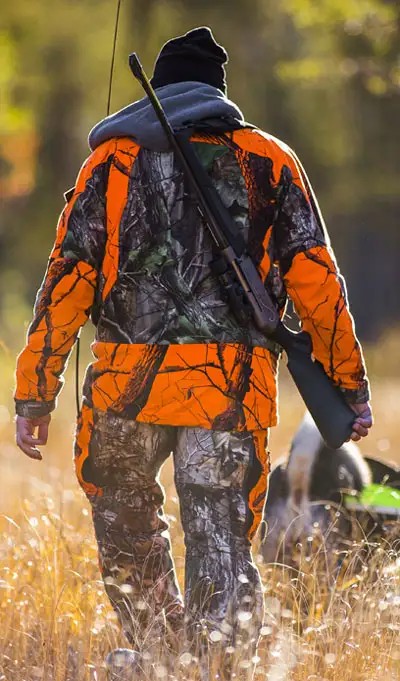
A riflescope for driven hunting needs different strengths from one for high-seat hunting or target shooting. Start with your main application, then compare the individual models.

Driven hunting
A wide field of view and low starting magnification make it easier to keep an overview. Compare field of view, viewing comfort and the illuminated dot.
Riflescopes for Driven hunting ↗
Stalking & mountain hunting
On long outings, weight and size matter. The magnification range should also suit the terrain and your typical viewing distances.
Riflescopes for Stalking & mountain hunting ↗
High-seat hunting
For high-seat hunting, image brightness, contrast and finely adjustable illumination matter. Compare the complete optical system, not just objective diameter.
Riflescopes for High-seat hunting ↗
Target shooting & long range
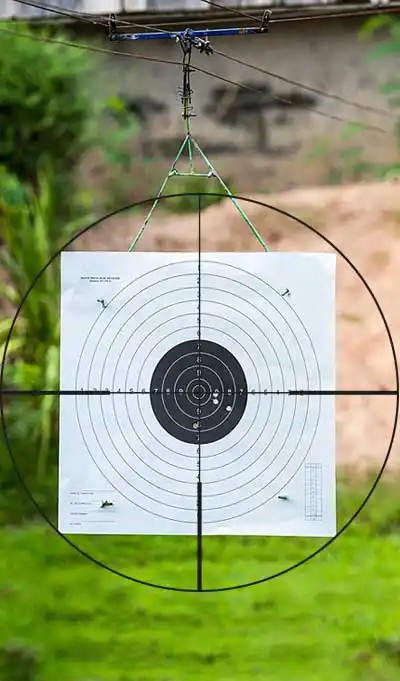
Reticle, focal plane and repeatable adjustment take centre stage. Explore the dedicated selection for long-distance shooting here.
Riflescopes for Target shooting & long range ↗Looking specifically for an optic for long distances? Explore our dedicated selection of long-range riflescopes.
Modern rifle scopes are designed for specific applications. From quick target acquisition on driven hunts and lightweight stalking scopes to bright images from a hide or tactical precision at long range, DDoptics offers scopes for hunters and target shooters that combine optical performance, robust mechanics and practical features.
Fast
Driven-hunt rifle scopes
Every second counts on a driven hunt. A suitable scope offers a wide field of view,
quick target acquisition, a clearly visible illuminated reticle and confident control on moving targets.
Lightweight
Stalking rifle scopes
A stalking scope must be manageable, precise and reliable. The essentials are
balanced weight, sharp images and a magnification range suited to woodland and open country.
Bright
Hide-hunting rifle scopes
Every detail matters when hunting from a hide. High light transmission, strong contrast and finely adjustable
reticle illumination help you identify game clearly in twilight and place shots accurately.
Precise
Target shooting & long range
Target and long-range shooting demand repeatable clicks, generous adjustment ranges,
clear reticles and robust mechanics that remain reliable under intensive use.
DDoptics rifle scopes are designed for specific hunting and target-shooting needs: fast on driven hunts, manageable when stalking, bright from a hide and precise on the range. Every hunter and target shooter can find the right scope for their application.